CloudEngine S16700 Series Switches
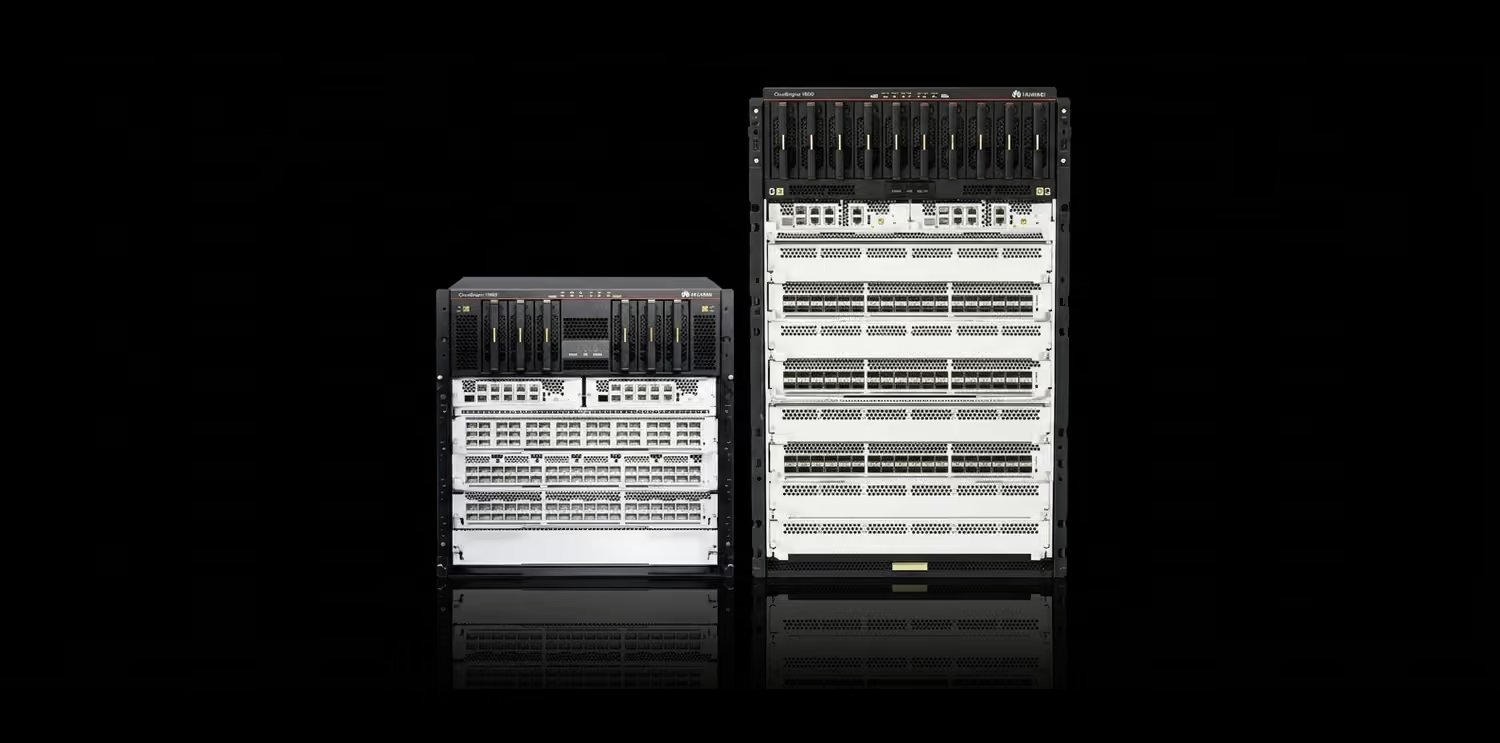
In today's hyper-connected enterprise environment, the campus network core is the critical hub for all data traffic. The Huawei CloudEngine S16700 Series is engineered to meet this demand, delivering flagship performance for high-quality, large-scale 10 Gbps campus networks. With a switching capacity of up to 76.8 Tbps and the ability to support 100,000 terminals on a single device, the S16700 provides the raw power to eliminate bottlenecks and ensure a seamless user experience for years to come.
Designed for extreme reliability and simplified operations, this series introduces advanced technologies like Multichassis Link Aggregation Group (M-LAG) and Virtual Extensible Local Area Network (VXLAN) to campus networks. Its future-proof architecture, featuring a backplane-free orthogonal design and 14.4 Tbit/s bandwidth per slot, ensures your network is prepared for the evolution towards the 400 Gbit/s era, protecting your investment and enabling long-term growth.
The CloudEngine S16700 Series redefines core switching with its state-of-the-art backplane-free orthogonal architecture. This design enables ultra-fast, non-blocking data forwarding, providing the massive capacity required for high-density environments and data-intensive applications. By delivering up to four times the industry average switching capacity, the S16700 ensures that your network can handle peak loads without performance degradation.
Beyond raw power, the S16700 is built for continuous operation. It is the first switch series to apply M-LAG technology to campus networks, enabling device-level link redundancy and uninterrupted service upgrades for 99.9999% reliability. It also integrates sophisticated O&M tools like the Packet Conservation Algorithm for Internet (iPCA), which provides real-time packet loss statistics for minute-level fault locating, drastically reducing troubleshooting time and improving network visibility.
Selecting the right core switch is a critical infrastructure decision with long-term implications. NEXUS ITX provides the focused, independent advisory services necessary to ensure the Huawei CloudEngine S16700 Series aligns perfectly with your organization's specific technical and operational requirements. We help you navigate the complexities of network architecture and product capabilities to make a confident, well-informed choice.
Our process focuses on a thorough evaluation of your environment, enabling you to build a resilient, scalable, and future-ready network core. We help you translate business needs into technical specifications, ensuring the chosen solution delivers lasting value.
Q: What is the primary difference between the CloudEngine S16700-4 and S16700-8 models?
A: The main difference lies in their physical capacity. The CloudEngine S16700-4 model features 4 service card slots, while the S16700-8 model provides 8 service card slots, offering greater port density and scalability for larger network environments.
Q: How does the backplane-free orthogonal architecture benefit the network?
A: This architecture allows data traffic between service cards to be switched directly, without needing to traverse a backplane. This significantly reduces latency, eliminates potential bottlenecks, and provides a clear, non-blocking path for ultra-fast forwarding, which is critical for supporting future high-bandwidth interfaces like 400GE.
Q: What is M-LAG and why is it significant for a campus network?
A: Multichassis Link Aggregation Group (M-LAG) allows two core switches to function as a single logical device from the perspective of an access switch. This provides device-level redundancy and load balancing. Its significance in a campus network is achieving extremely high reliability (99.9999%) and enabling hitless upgrades, where one core switch can be updated without interrupting network services.
Q: Can the CloudEngine S16700 integrate into a network with switches from other vendors?
A: Yes, the S16700 series is designed for interoperability. It supports protocols like VBST (compatible with PVST/PVST+/RPVST), LNP (similar to DTP), and VCMP (similar to VTP) to ensure seamless integration and operation within multi-vendor network environments.
Q: How does the S16700 handle network virtualization?
A: The S16700 uses Virtual Extensible Local Area Network (VXLAN) with a BGP-EVPN control plane. This technology decouples the logical network from the physical network, allowing the creation of large-scale virtual fabrics that span the entire campus. This supports features like free mobility, where user policies and network access remain consistent regardless of their physical location.
Q: What is iPCA and how does it improve network operations?
A: The Packet Conservation Algorithm for Internet (iPCA) is a technology that provides real-time statistics on packet loss and other key performance indicators. It measures quality on actual service flows without impacting performance, allowing network administrators to locate faults at a minute-level granularity and significantly improve O&M efficiency.
Contact Nexus ITX to discuss your technical requirements and assess which CloudEngine S16700 model is the right fit for your organization's goals.