CloudEngine S6780-H Series Switches
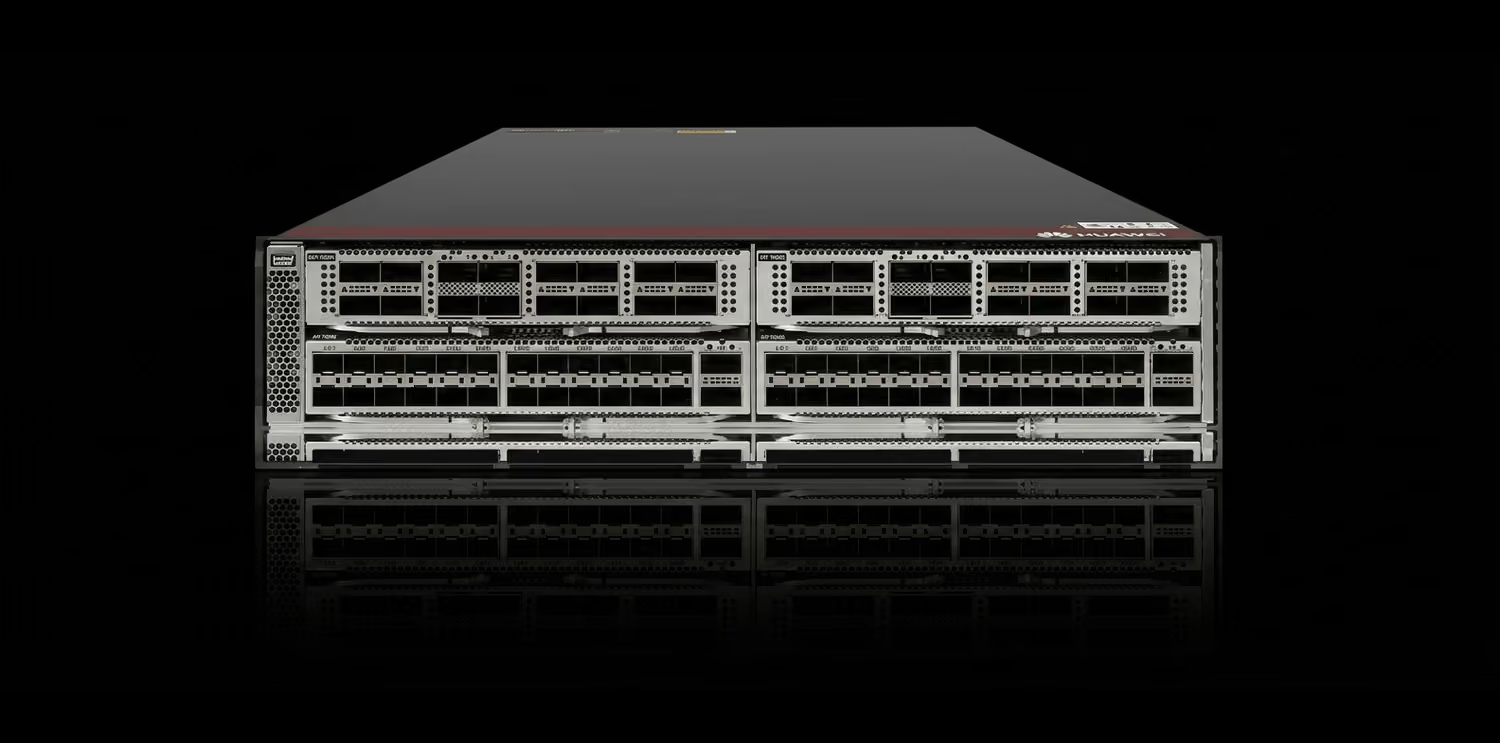
In today's hyper-connected enterprise, the network core is the critical hub for digital transformation. The Huawei CloudEngine S6780-H Series is engineered to meet this demand, delivering next-generation performance for large-scale campus core and aggregation layers. With a switching capacity of up to 16 Tbps and forwarding performance reaching 2400 Mpps, these switches are built to handle intensive cloud, IoT, and high-bandwidth application traffic without bottlenecks.
Designed for scalability and long-term value, the S6780-H series utilizes a flexible card architecture within a compact 2U chassis. This allows your network to evolve alongside your business, adapting to changing port density and speed requirements. By integrating advanced security, intelligent operations, and cloud-native capabilities, the S6780-H provides a robust foundation for a secure, agile, and high-performance enterprise network.
The CloudEngine S6780-H series stands apart with its innovative flexible card design. Four half-width card slots allow for customized configurations, supporting a mix of high-density 10GE, 25GE, 40GE, 100GE, and even 400GE ports. This modularity ensures your initial investment is protected while providing a clear path to future network upgrades, whether you are building the core for a large campus or aggregating traffic from multiple access layers.
Beyond raw performance, these switches are equipped with sophisticated software capabilities to support modern network paradigms. Built-in support for VXLAN with BGP EVPN enables the creation of scalable, virtualized networks that extend across physical locations. Features like SRv6 and network slicing provide the tools to build programmable, service-aware networks, while MACsec encryption secures data from end to end at the MAC layer, protecting critical information as it traverses the campus.
Selecting the right core or aggregation switch is a critical decision that impacts your network's performance, scalability, and security for years to come. The Huawei CloudEngine S6780-H Series offers a wide range of models, port cards, and advanced software features, and navigating these options requires a clear understanding of your specific architectural and operational requirements.
NEXUS ITX helps organizations align technology capabilities with business outcomes. We facilitate a thorough evaluation process, focusing on your unique technical needs and future growth plans to help you determine if the S6780-H Series is the optimal solution for your environment.
Q: What is the primary advantage of the CloudEngine S6780-H's flexible card architecture?
A: The main advantage is investment protection and scalability. The four half-width card slots allow you to start with your current port requirements (e.g., high-density 10GE/25GE) and add higher-speed interfaces like 100GE or 400GE as your network demands grow, all within the same 2U chassis.
Q: How does the S6780-H series support network virtualization?
A: It provides comprehensive support for VXLAN (Virtual Extensible LAN), which allows for the creation of large, isolated Layer 2 networks over a Layer 3 infrastructure. It can function as both a distributed and centralized VXLAN gateway and uses BGP EVPN as the control plane to automate VTEP discovery and MAC address learning.
Q: What kind of performance does the S6780-H4Z model offer?
A: The CloudEngine S6780-H4Z model delivers enterprise-class core performance, with a forwarding rate of up to 2400 Mpps (Million packets per second) and a switching capacity of 14.4Tbps, which can be extended to 16Tbps.
Q: What is MACsec and how does it secure the network?
A: MACsec is an IEEE 802.1AE standard that provides Layer 2 security. It encrypts data on a hop-by-hop basis between connected switches or between a switch and a client. This protects against eavesdropping, man-in-the-middle attacks, and data tampering directly on the wire.
Q: Can the CloudEngine S6780-H be integrated into a network with equipment from other vendors?
A: Yes, it is designed for interoperability. It supports protocols like VBST (compatible with Cisco's PVST/PVST+/RPVST), LNP (similar to DTP), and VCMP (similar to VTP), which facilitates smoother integration into existing multi-vendor environments.
Q: What is the benefit of iPCA for network operations?
A: iPCA (in-situ Flow Information Telemetry) provides real-time visibility into network quality. It directly measures packet loss and latency statistics on service flows, allowing network administrators to detect and troubleshoot performance issues proactively before they impact users.
Q: How can NEXUS ITX help me choose the right combination of flexible cards for my S6780-H switch?
A: Nexus ITX can assist in the evaluation process by helping you analyze your current and projected traffic patterns, port density needs, and uplink speed requirements. This requirements-based approach helps align the various card options—such as 24-port 10GE/25GE or 8-port 25GE + 4-port 400GE cards—with your specific operational and budgetary objectives.
Contact us to discuss your specific technical requirements and assess the right S6780-H configuration for your campus core or aggregation needs.