CloudEngine S8700 Series Switches
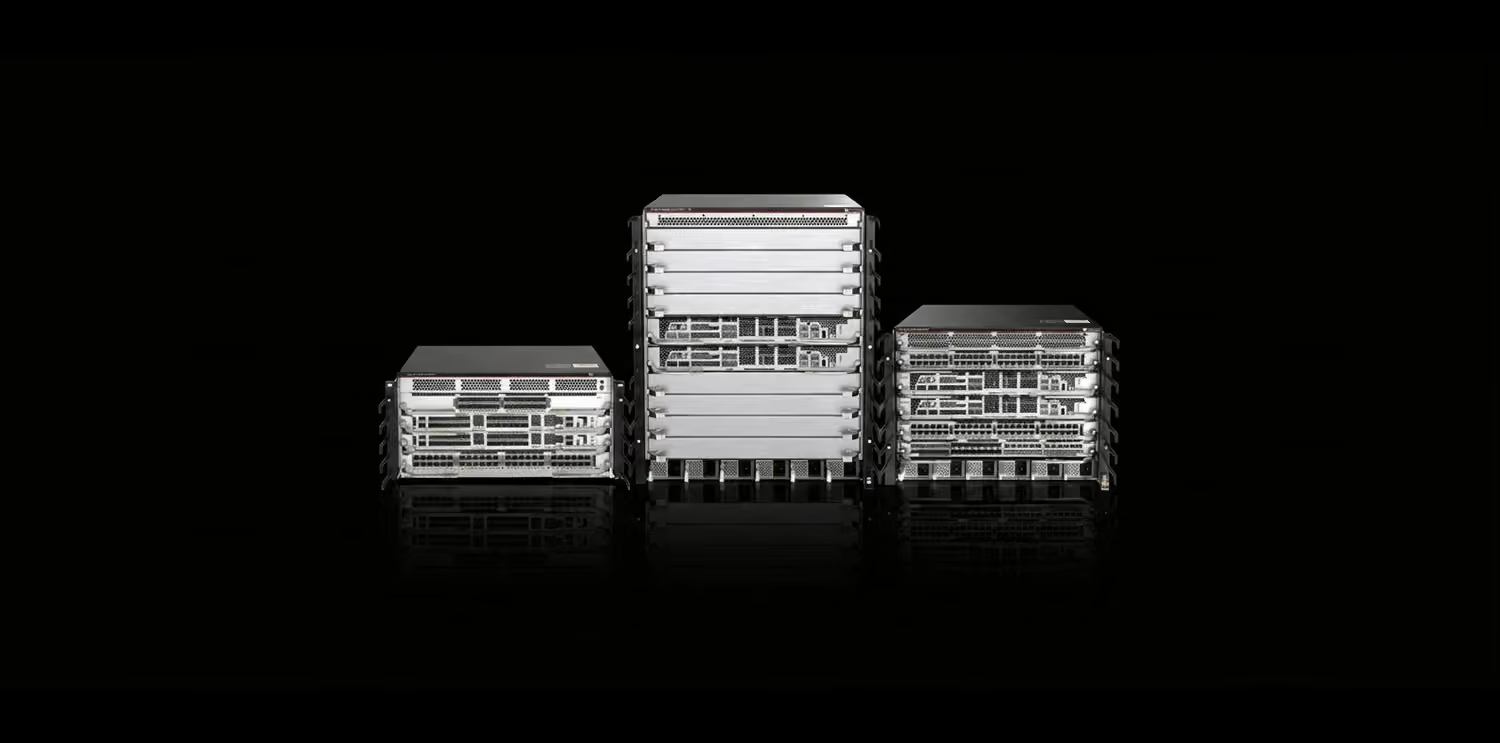
As campus networks evolve to support high-bandwidth applications, IoT, and hybrid work models, the demand for a stable, high-performance, and intelligent network core has never been greater. Legacy infrastructure often struggles to keep pace, creating bottlenecks that impact productivity and user experience. A modern network requires a foundation built for capacity, reliability, and security from the ground up.
The Huawei CloudEngine S8700 Series Switches are engineered to meet these challenges head-on. Designed as next-generation modular switches for enterprise networks, they provide powerful Layer 2/Layer 3 switching, extensive service capabilities, and a highly resilient architecture. With switching capacities up to 8Tbps and industry-leading port density, the S8700 series delivers the performance and scalability needed to power digital transformation across demanding campus environments.
The CloudEngine S8700 series is built on Huawei's intelligent multi-layer switching technology, delivering a comprehensive suite of features that go beyond basic connectivity. The platform intelligently identifies over 6000 applications, enabling granular QoS policies and ensuring critical services receive priority. This deep visibility provides an optimized and consistent user experience, even during periods of high network congestion.
Reliability is at the core of the S8700 design. Innovative active-active main control boards facilitate rapid, hitless failover, ensuring service continuity for mission-critical operations. The modular chassis, with redundant power supplies and fan modules, further enhances system uptime. This resilient architecture makes the S8700 an ideal choice for organizations that cannot afford network downtime.
Selecting the right campus switch involves a detailed analysis of current needs and future growth objectives. Factors like port density, PoE budget, uplink capacity, and software features must be carefully matched to your specific technical and business requirements. Making the wrong choice can lead to performance bottlenecks, limited scalability, and increased operational complexity.
Nexus ITX helps organizations navigate the complexities of network hardware evaluation. We provide the clarity needed to compare different models and configurations of the CloudEngine S8700 series, ensuring your final selection is a perfect fit for your environment.
Q: What is the primary difference between the CloudEngine S8700 models?
A: The primary differences are in physical size and capacity. The S8700-4/4S, S8700-6, and S8700-10 models offer 2, 4, and 8 service card slots respectively. This translates to different maximum switching capacities, with the S8700-10 offering the highest at 8Tbps.
Q: What makes the S8700's reliability 'ultra-high'?
A: The platform's high reliability stems from its hardware redundancy. Key features include innovative active-active main control boards for rapid failover, support for up to 6 system power supplies, and multiple fan slots, ensuring no single point of failure compromises network availability.
Q: How does the S8700 support Power over Ethernet (PoE) at distances beyond the standard 100 meters?
A: The S8700 features hybrid optical-electrical ports. When used with a compatible hybrid cable, these ports can deliver PoE++ (up to 90W) to powered devices at distances up to 300 meters, overcoming traditional Ethernet distance limitations.
Q: What network virtualization technologies are supported by the CloudEngine S8700?
A: The S8700 series supports VXLAN, a key technology for building scalable, virtualized networks. It can function as both a Layer 2 and Layer 3 VXLAN gateway in centralized or distributed deployments and uses BGP-EVPN for control plane automation.
Q: How does the switch handle security at the port level?
A: The S8700 supports MACsec, an IEEE 802.1AE standard that provides hop-by-hop data encryption on wired Ethernet links. This secures data transmission between trusted components on the network, preventing eavesdropping and data tampering.
Q: Can the S8700 be deployed in a pure IPv6 network?
A: Yes. The S8700 platform supports a full IPv4/IPv6 dual stack and includes a comprehensive suite of IPv6 routing protocols, such as RIPng, OSPFv3, BGP4+, and IS-ISv6, making it suitable for seamless integration into IPv6 or hybrid network environments.
Q: How can I determine which S8700 model and service cards are right for my organization?
A: The ideal configuration depends on your specific requirements for port density, interface types (e.g., 10GE, 40GE), PoE budget, and future scalability. Nexus ITX can help you evaluate these technical requirements to compare the different chassis and card options effectively.
Contact Nexus ITX to discuss your technical requirements and evaluate the best S8700 model for your campus network.