HPE ProLiant Tower Servers
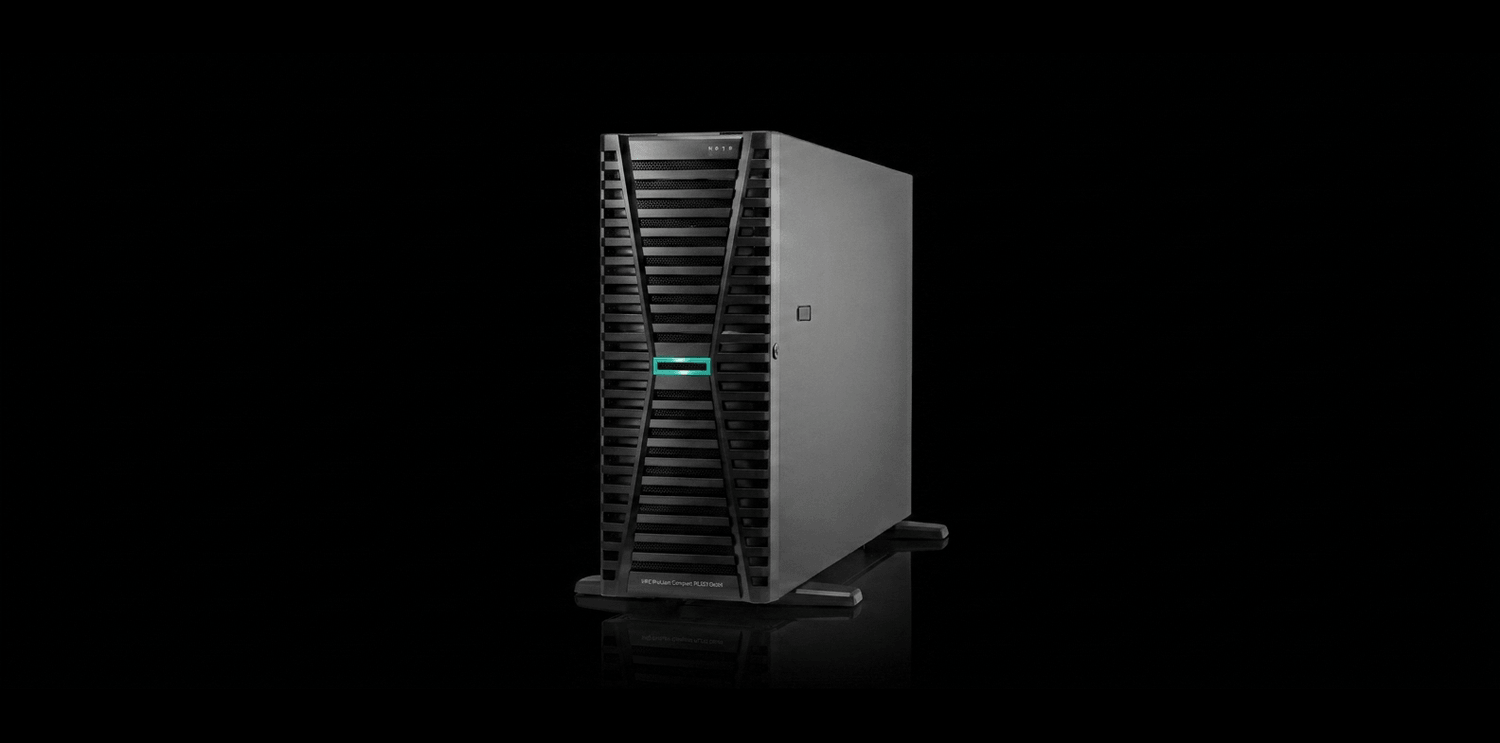
HPE ProLiant Tower Servers provide a powerful foundation for on-premises and hybrid cloud environments, delivering a strategic balance of performance, security, and expandability. Designed for organizations ranging from small businesses to distributed enterprises, this server family addresses the need for reliable compute power outside of a traditional data center, without compromising on enterprise-class capabilities.
From the ultra-compact MicroServer Gen11 for small office spaces to the robust dual-processor ML350 Gen12 for demanding workloads, each ProLiant Tower server is engineered for operational efficiency and long-term value. With support for the latest Intel® Xeon® processors, high-speed DDR5 memory, and PCIe Gen5 connectivity, these servers are built to handle core business applications, IT infrastructure, and data management tasks today while offering the headroom for future growth.
The HPE ProLiant Tower Server portfolio is built on a foundation of security that begins at the silicon level. Every server features the HPE iLO silicon root of trust, which creates an immutable digital fingerprint in the hardware itself. This prevents the server from booting with compromised firmware, providing a fundamental layer of protection against sophisticated threats before the operating system even loads.
Flexibility is central to the ProLiant Tower design. Many models, such as the ML110 and ML350, offer the versatility to start in a tower form factor and later convert to a rack-mount configuration as your infrastructure evolves. This adaptability, combined with extensive expansion slots, flexible storage options including LFF, SFF, and EDSFF drives, and optional redundant power supplies, allows you to build a resilient and scalable IT environment tailored to your specific operational needs.
Selecting the right server involves balancing immediate performance needs with future scalability, security posture, and budget. The HPE ProLiant Tower family offers a wide range of models and configuration options, each suited to different workloads and operational environments. Nexus ITX helps organizations navigate these choices to ensure the selected server architecture aligns perfectly with their technical and business objectives.
Our approach focuses on a detailed evaluation of your specific use cases, from branch office file sharing to enterprise-level VDI or database applications. By analyzing your requirements, we can help identify the ProLiant Tower model that provides the optimal blend of processing power, memory, storage, and expandability.
Q: What is the main difference between the HPE ProLiant ML110 and ML350 models?
A: The HPE ProLiant ML350 (Gen11/Gen12) is a dual-processor (2P) capable server designed for higher-performance workloads and greater scalability, supporting more memory and storage. The HPE ProLiant ML110 Gen11 is a single-processor (1P) server optimized for SMB and ROBO environments, offering a strong balance of performance and value with significant expansion capabilities.
Q: Can HPE ProLiant Tower Servers be used in a server rack?
A: Yes, several models, including the ML110 Gen11 and ML350 Gen11, are designed with flexibility in mind. They can be deployed as a standalone tower and later converted to a rack-mount configuration using an optional conversion kit, allowing them to adapt as your infrastructure needs change.
Q: What is HPE iLO silicon root of trust?
A: It is a fundamental security feature embedded directly into the HPE server hardware (ASIC). It creates a unique, unchangeable digital fingerprint that validates the server's core firmware before it is allowed to boot. This protects the server from low-level, firmware-based attacks that traditional security software cannot detect.
Q: What are the benefits of PCIe Gen5 support?
A: PCIe Gen5 provides double the data transfer bandwidth of the previous generation, PCIe Gen4. This allows for higher performance from expansion cards like next-generation network adapters, Fibre Channel HBAs, and high-speed storage controllers, reducing I/O bottlenecks for data-intensive applications.
Q: What kind of workloads is the HPE ProLiant MicroServer Gen11 best suited for?
A: The MicroServer Gen11 is an ultra-compact, entry-level server ideal for small offices, home offices (SOHO), or edge locations with limited space. It's well-suited for file and print services, light application hosting, and serving as a central data hub for a small team.
Q: Do these servers support redundant power supplies?
A: Yes, models such as the ML110 Gen11 and ML30 Gen11 offer optional redundant power supplies. This feature provides high availability by allowing the server to continue operating even if one power supply unit fails, ensuring greater uptime for critical business operations.
Contact us to discuss your workload requirements and evaluate which ProLiant Tower model aligns with your IT strategy.