HPE Synergy
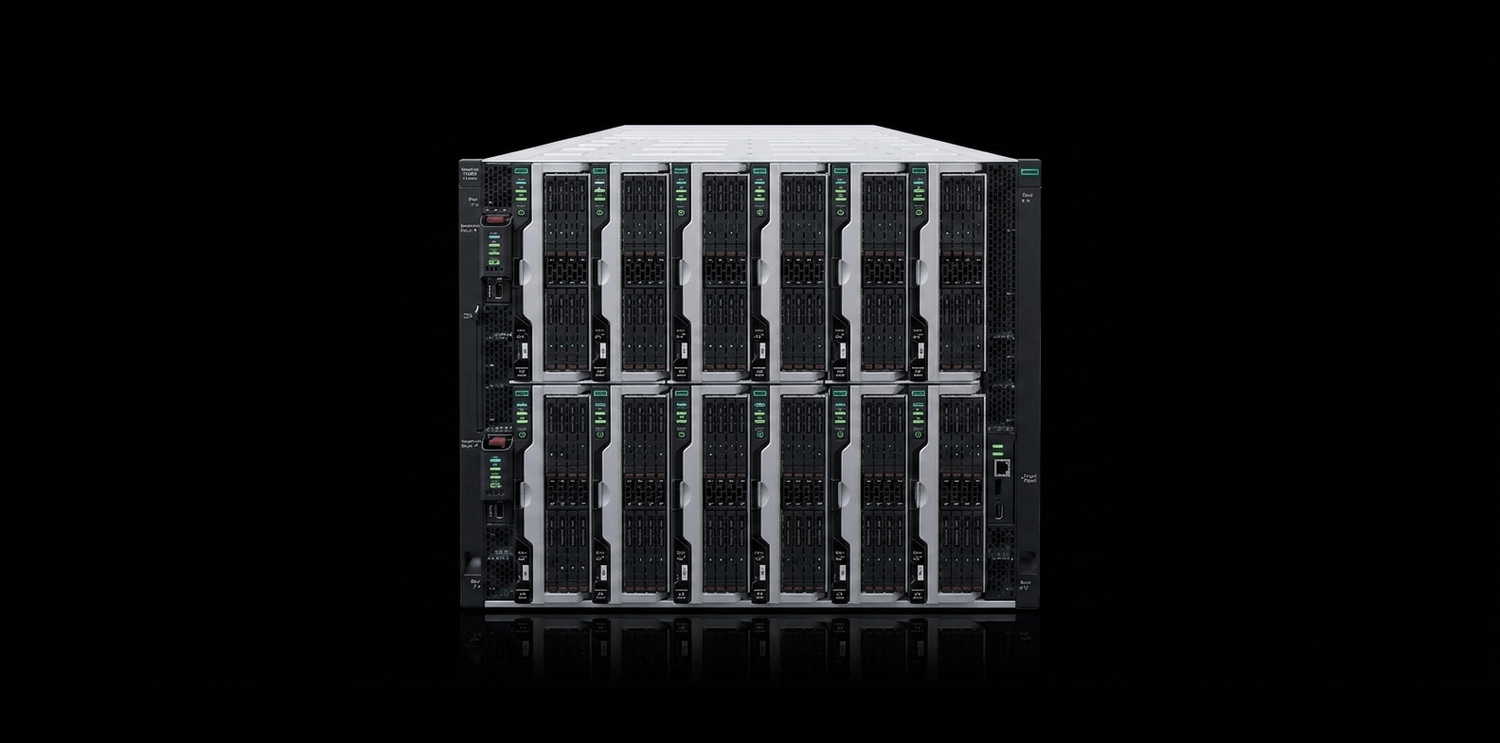
In today's hybrid IT landscape, the pressure to deliver services faster while managing complex environments is immense. Traditional infrastructure often creates rigid silos, slowing down application delivery and increasing operational overhead. This can hinder your ability to innovate and respond to business demands with the speed and flexibility of the cloud.
HPE Synergy addresses this challenge by fundamentally changing how you manage and deploy IT resources. It is a single, intelligent platform built on the principles of composable infrastructure, allowing you to treat physical hardware as a fluid pool of resources. Instead of manually configuring servers, storage, and networking for each new application, you can precisely compose the required infrastructure in minutes through software, eliminating friction and accelerating your time-to-market.
HPE Synergy is a groundbreaking platform that blurs the lines between physical and virtual infrastructure. Its software-defined intelligence, powered by HPE OneView and HPE Synergy Composer, allows you to programmatically control and automate your entire hardware stack. This unified API enables developers and IT operations to provision resources on-demand, just like a public cloud, but with the performance, security, and control of on-premises hardware.
By breaking down compute, storage, and fabric into disaggregated, composable elements, Synergy eliminates overprovisioning and stranded capacity. You can dynamically recompose resources to meet the exact needs of any workload—from traditional virtualized applications and VDI to containerized microservices. This unique architecture provides a seamless foundation for your hybrid cloud strategy, simplifying operations and empowering rapid innovation.
Navigating the complexities of composable infrastructure requires a clear understanding of how it aligns with your specific operational goals and existing environment. The HPE Synergy platform offers extensive configuration possibilities, and selecting the right components—from compute modules and frames to fabric interconnects—is critical for achieving the desired performance, scalability, and TCO.
Nexus ITX helps organizations thoroughly evaluate the HPE Synergy ecosystem against their technical and business requirements. We facilitate a detailed assessment process to ensure the proposed architecture is the right fit for your workloads, automation strategy, and long-term hybrid cloud vision.
Q: What is composable infrastructure?
A: Composable infrastructure is an architectural approach that treats physical compute, storage, and network fabric resources as fluid pools that can be programmatically discovered, composed, and deployed to fit the specific needs of an application. HPE Synergy uses this principle to provide cloud-like agility for on-premises hardware.
Q: How is HPE Synergy managed?
A: The platform is managed through a combination of HPE Synergy Composer and HPE OneView. Synergy Composer provides the native infrastructure management, while HPE OneView delivers software-defined intelligence and a unified API to automate the entire infrastructure lifecycle.
Q: What is the main compute component of the HPE Synergy platform?
A: The primary compute component is the HPE Synergy 480 Gen12 Compute Module, a two-socket, half-height module featuring Intel® Xeon® 6 processors designed for general-purpose enterprise workloads.
Q: How does HPE Synergy scale?
A: Scalability is achieved by linking multiple HPE Synergy 12000 Frames. Using the HPE Synergy Frame Link Module, you can connect up to 21 frames into a single management ring, all controlled from a single interface.
Q: What kind of networking performance does HPE Synergy offer?
A: HPE Synergy offers high-performance networking through its Virtual Connect modules. It supports 25/50 Gb downlink speeds to compute modules, 100 Gb uplinks for high-speed core network connectivity, and converged 16/32 Gb Fibre Channel for SAN interconnectivity.
Q: Can HPE Synergy run both virtualized and containerized applications?
A: Yes. It is designed to be a versatile platform capable of running a wide range of workloads simultaneously, including traditional applications on virtual machines, containerized cloud-native services, and bare-metal deployments.
Q: What is the Unified API and why is it important?
A: The Unified API is a single, powerful interface provided by HPE OneView that allows IT teams and developers to control the infrastructure with code. This is crucial for enabling DevOps practices and automation, as it allows infrastructure services to be provisioned and managed in minutes without manual intervention.
Contact us to explore how HPE's composable infrastructure can align with your hybrid cloud strategy and workload-specific needs.