NetEngine 8000E F8
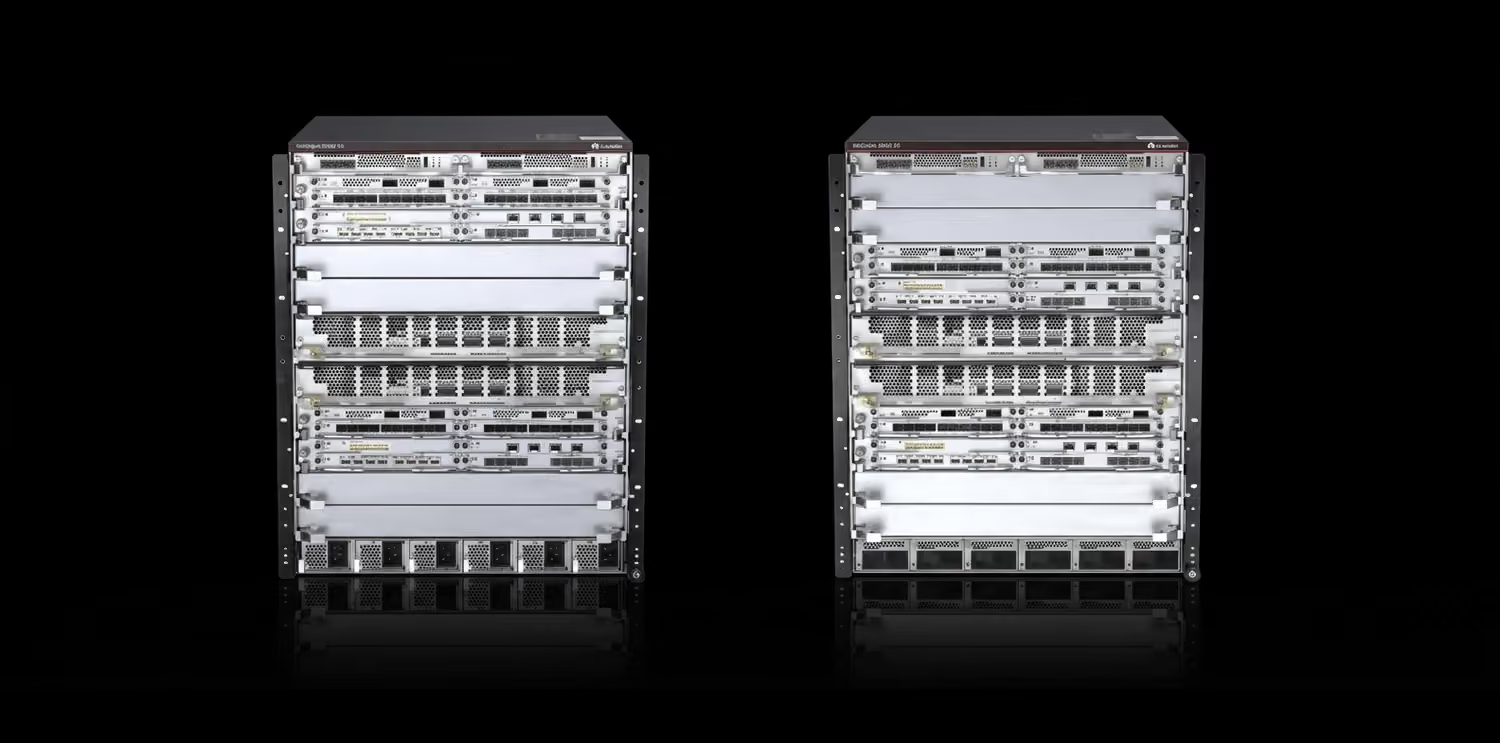
In the era of explosive traffic growth and diverse service demands, network infrastructure must evolve beyond simple connectivity. The challenge is to build a core network that is not only powerful and scalable but also simplified, intelligent, and supremely reliable. Your architecture needs to support everything from 5G mobile backhaul and enterprise private lines to massive broadband access and seamless cloud interconnection without adding layers of complexity.
The Huawei NetEngine 8000E F8 is an ultra-high-density multi-service router engineered to meet these challenges head-on. It provides a robust foundation for building next-generation IP bearer networks by consolidating multiple critical functions into a single, compact 13U platform. With a switching capacity of up to 28.86 Tbit/s and extensive high-density port options up to 400GE, the NetEngine 8000E F8 delivers the raw performance required to handle today’s data deluge and tomorrow’s unforeseen demands.
The NetEngine 8000E F8 fundamentally streamlines network architecture by functioning as an all-in-one platform. It can concurrently operate as a PE router, Broadband Network Gateway (BNG), SR Gateway, Data Center Gateway (DC-GW), and Carrier-Grade NAT (CGN) device. This consolidation eliminates the need for multiple specialized hardware appliances, reducing capital expenditure, power consumption, and operational complexity. By unifying these services, organizations can create a flatter, more efficient, and easier-to-manage network topology.
This powerful consolidation is enabled by a suite of advanced technologies. Native SRv6 (Segment Routing over IPv6) support simplifies network protocols and allows for intelligent, application-aware traffic steering, enabling one-hop access to cloud services. For services requiring stringent performance, Flex-E (Flexible Ethernet) provides hardware-isolated network slicing, creating virtual pipes with guaranteed bandwidth and deterministic latency to ensure critical Service Level Agreements (SLAs) are always met.
Selecting a core router like the NetEngine 8000E F8 is a critical architectural decision that impacts network performance, scalability, and operational efficiency for years to come. The platform's extensive capabilities and configuration options require a thorough evaluation to ensure a perfect fit for your specific environment and business objectives.
Nexus ITX facilitates a structured and data-driven evaluation process. We help organizations analyze the NetEngine 8000E F8's features against their unique technical and operational requirements, ensuring the final architecture is optimized, resilient, and future-proof.
Q: What is the main advantage of the NetEngine 8000E F8's "all-in-one" design?
A: The primary advantage is network simplification. By consolidating multiple network functions like PE, BNG, DC-GW, and CGN onto a single platform, it reduces the number of physical devices required. This leads to lower capital and operational costs, a smaller physical footprint, reduced power consumption, and a simplified management domain.
Q: How does the NetEngine 8000E F8 ensure high availability for critical services?
A: It achieves carrier-grade reliability through comprehensive redundancy. All key components, including main control boards (MCUs), fabric boards, power supplies, and fans, are fully redundant with 1:1 hot standby. It also utilizes hardware-based BFD and Fast Reroute (FRR) to achieve millisecond-level fault detection and service switchover, ensuring non-stop operations.
Q: What is SRv6 and what problem does it solve?
A: SRv6 (Segment Routing over IPv6) is a next-generation network protocol that simplifies the network control plane. It steers packets using a list of instructions embedded in the IPv6 header, eliminating the need for complex signaling protocols like LDP and RSVP-TE. This results in simplified network operations, easier automation, and the ability to create intelligent, application-aware traffic paths for optimized service delivery.
Q: How does Flex-E hardware slicing differ from traditional QoS?
A: While traditional QoS prioritizes traffic within a shared link, Flex-E (Flexible Ethernet) creates physically isolated, dedicated channels at the hardware level. This provides hard isolation between different services or tenants, offering guaranteed bandwidth and deterministic low latency that cannot be impacted by other traffic on the router. It is ideal for services with stringent SLA requirements.
Q: What is iFIT and how does it improve network O&M?
A: iFIT (In-situ Flow Information Telemetry) is a technology that provides real-time, flow-level visibility into network performance. It collects packet loss, latency, and jitter metrics directly from service packets without impacting performance. When used with the iMaster NCE platform, it enables AI-driven O&M, allowing operators to visualize SLA status in real-time and pinpoint fault locations within minutes.
Q: What are the maximum port capacities of the NetEngine 8000E F8?
A: The router has a port capacity of up to 6.4 Tbit/s. It supports a high density of various interfaces, with maximums including 64x400GE, 64x100GE, 256x25GE, or 576x10GE ports, providing significant flexibility for different network scenarios.
Q: How can I determine which model (AC or DC) and configuration is right for my organization?
A: The choice between the AC and DC models depends on your facility's power infrastructure, with DC power being common in telecommunications and data center environments. The optimal line card and interface configuration depends on your specific use cases, traffic patterns, and scalability requirements. Nexus ITX can help you analyze these factors to align the most suitable configuration with your needs.
Contact Nexus ITX to analyze your technical requirements and align the right router configuration with your architectural goals.