NetEngine 8000E M14 Universal Service Router
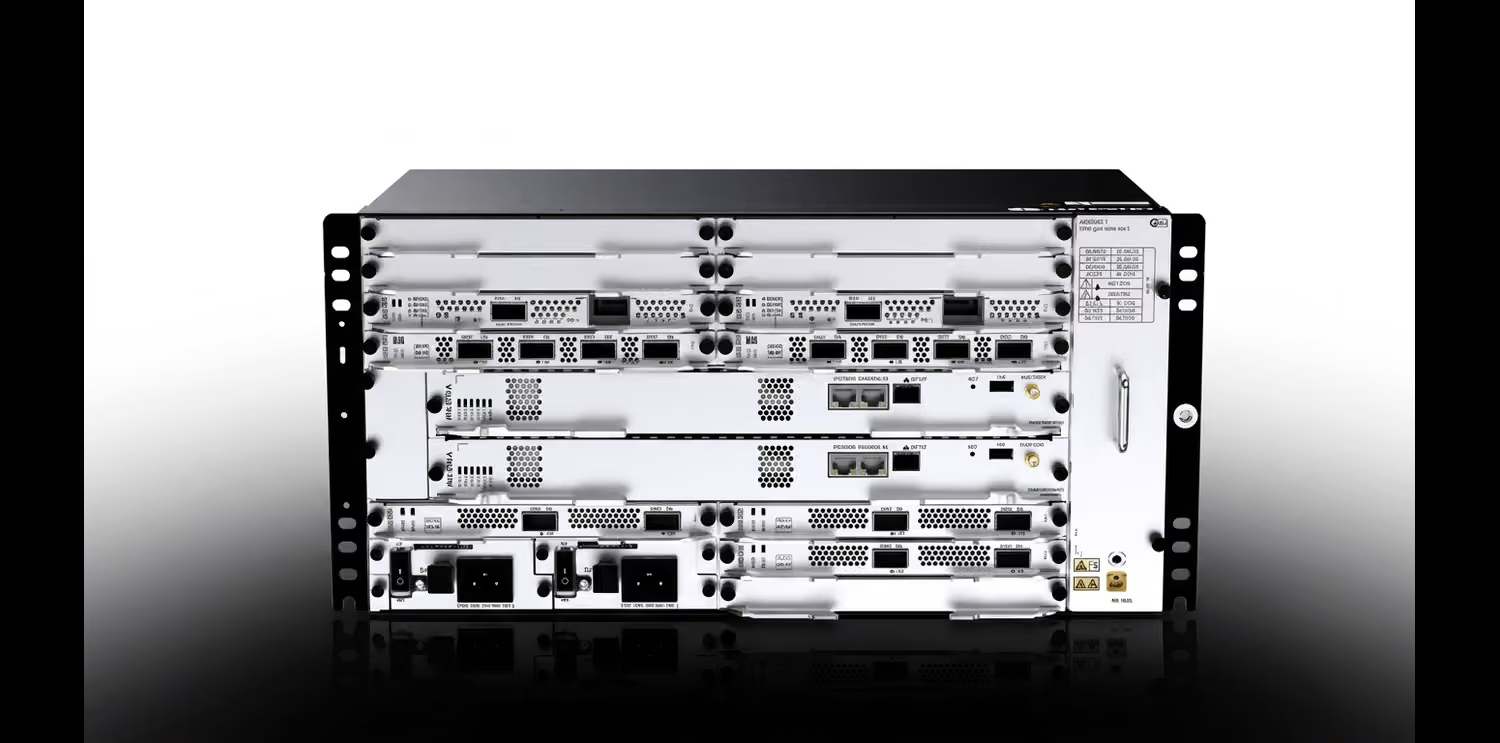
Modern IP bearer networks demand unprecedented performance, flexibility, and intelligence, often within strict physical constraints. The Huawei NetEngine 8000E M14 Universal Service Router directly addresses these challenges, delivering up to 7.2 Tbps of switching capacity in a remarkably compact 5U, 220mm-deep chassis. This industry-leading density allows for flexible deployment in access and aggregation scenarios, even co-locating with access devices in a single cabinet.
Engineered as an all-scenario intelligent router, the NetEngine 8000E M14 consolidates multiple network functions into a single, unified platform. It acts as a converged bearer for home broadband, enterprise private lines, mobile backhaul, and cloud services, simplifying network architecture, reducing operational complexity, and lowering total cost of ownership. By integrating advanced automation and O&M capabilities, it provides a robust foundation for building the next generation of intelligent, autonomous wide-area networks.
The NetEngine 8000E M14 is built on a programmable Network Processor (NP) architecture, ensuring it can adapt to future protocol and service evolution. Its core strength lies in its ability to simplify complex network environments. By leveraging Segment Routing over IPv6 (SRv6), it enables automated cross-domain connections, one-hop cloud access, and intelligent traffic steering based on application latency and bandwidth requirements. This technology significantly reduces protocol complexity, streamlining both provisioning and day-to-day operations.
Further enhancing its versatility, the router supports network slicing with FlexE technology. This allows for the creation of isolated, dedicated network resources on a single physical infrastructure, ensuring diverse services with varying SLA requirements can coexist without interference. Combined with intelligent O&M powered by iMaster NCE and In-situ Flow Information Telemetry (IFIT), the M14 offers real-time service quality visualization and minute-level fault locating, transforming network management from reactive to proactive.
Selecting the right universal service router requires a thorough analysis of network architecture, service requirements, and future growth objectives. Nexus ITX facilitates a structured evaluation of the Huawei NetEngine 8000E M14, ensuring the chosen configuration aligns precisely with your technical and operational needs.
We help organizations navigate the complexities of network hardware selection by focusing on data-driven comparison and alignment with your specific use cases. The process is designed to provide clarity and confidence before any acquisition commitment is made.
Q: What is the main advantage of the NetEngine 8000E M14's compact 5U design?
A: The primary advantage is its deployment flexibility. At just 220mm deep, it can be installed in standard 300mm deep cabinets, allowing it to be co-deployed with access devices like OLTs or MSANs. This saves significant space and power in central offices or aggregation sites compared to larger, traditional core routers.
Q: How does the '4-in-1' converged platform benefit a network operator?
A: It significantly simplifies the network architecture. Instead of deploying separate physical devices for private lines, internet gateways, data center gateways, and broadband services (BNG), the NetEngine 8000E M14 can perform all these functions simultaneously on one platform. This reduces the number of network nodes, lowers CapEx and OpEx, and simplifies network management.
Q: What is SRv6 and why is it a key feature?
A: SRv6 (Segment Routing over IPv6) is a next-generation networking protocol that simplifies traffic engineering and service provisioning. It embeds path information directly into IPv6 packet headers, eliminating the need for complex signaling protocols like LDP and RSVP-TE. For the M14, this means faster service provisioning, automated cross-domain connections, and intelligent, application-aware traffic steering to meet SLAs.
Q: Can this router support both legacy and modern network interfaces?
A: Yes, one of its key strengths is its comprehensive interface support. It supports everything from legacy interfaces like E1, POS, and cPOS (from 64K) up to the latest high-speed interfaces, including 100GE and 400GE. This makes it an ideal platform for network modernization, allowing for a gradual migration from older technologies to a modern IP-based infrastructure.
Q: What are the differences between the AC and DC models?
A: The primary differences are the power supply type and the number of available service slots. The DC model uses -40V to -72V DC power, typical in telecommunications facilities, and offers 14 service slots. The AC model uses standard 100V-240V AC power (or 240V HVDC) and provides 12 service slots. The choice depends entirely on the power infrastructure available at the deployment site. Nexus ITX can help evaluate which model is suitable for your environment.
Q: How does In-situ Flow Information Telemetry (IFIT) improve network operations?
A: IFIT provides unprecedented visibility into network performance. It allows the router to collect real-time, per-packet performance data (like latency and packet loss) for every service flow. When used with iMaster NCE, this data is visualized, enabling operators to monitor SLAs in real-time and locate faults within minutes, dramatically reducing troubleshooting time.
Contact us to discuss your technical requirements and assess how this universal service router can enhance your network architecture.