NetEngine 8000E M1C Universal Service Router
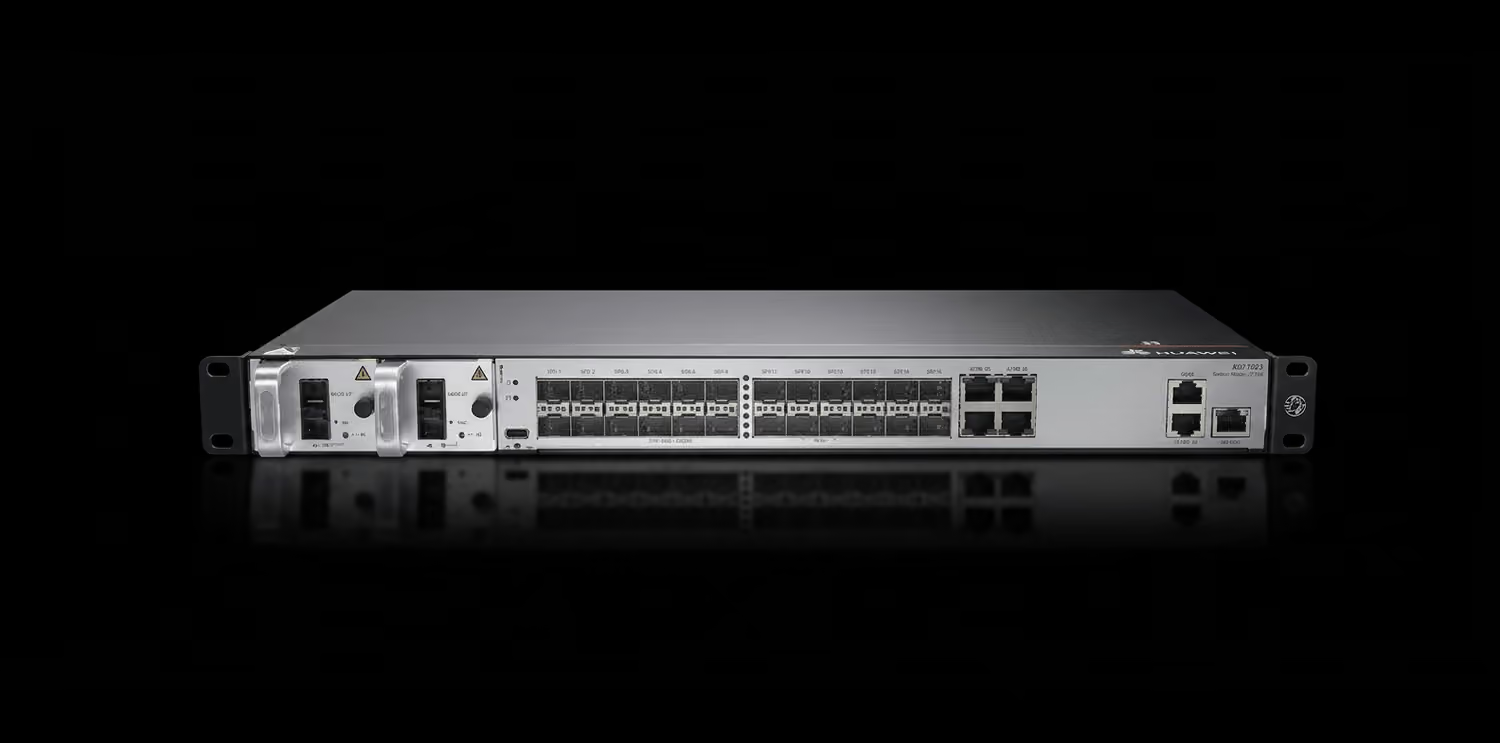
In an era defined by cloud adoption and explosive data growth, network infrastructure must deliver more performance in less space. The Huawei NetEngine 8000E M1C Universal Service Router is engineered to meet this demand, packing high-density service access and advanced routing capabilities into a compact 1U chassis. With up to 172 Gbps port capacity and a 344 Gbps switching capacity, it provides the performance needed for demanding metro, data center, and enterprise WAN environments.
Designed for the future of intelligent networking, the NetEngine 8000E M1C is built on a programmable architecture. It fully supports next-generation protocols like SRv6 and EVPN, simplifying network operations and enabling greater service agility. This combination of a space-saving design, low power consumption, and forward-looking features makes it a versatile foundation for building scalable, efficient, and intelligent IP networks.
The NetEngine 8000E M1C delivers exceptional routing performance without requiring significant rack space. Its 1U height and 220mm depth make it ideal for deployment in constrained locations, from edge sites to crowded data center cabinets. Available in both AC and DC power models, and built to operate in a wide industrial temperature range (-40°C to 65°C), it offers the physical versatility to fit diverse operational environments while maintaining low typical power consumption.
Beyond its physical attributes, the router is a platform for network innovation. It leverages a programmable Network Processor (NP) to support advanced technologies that drive efficiency and service quality. Features like Deterministic IP (DIP) provide guaranteed low latency for critical applications, while Data Redundancy Elimination (DRE) optimizes WAN bandwidth. With comprehensive support for telemetry, it integrates seamlessly into intelligent O&M systems, providing the visibility needed to manage modern, complex networks.
Selecting the right universal service router is critical for network performance, scalability, and operational efficiency. Aligning the advanced capabilities of the NetEngine 8000E M1C with your specific architectural and business requirements is the first step toward a successful deployment. Nexus ITX provides the independent, technically-grounded advisory to facilitate this evaluation process.
We help organizations navigate the complexities of modern network infrastructure by focusing on a requirements-led approach. By analyzing your unique use cases, performance targets, and future growth plans, we can help you determine if the NetEngine 8000E M1C is the optimal fit for your environment.
Q: What is the primary advantage of the NetEngine 8000E M1C's compact 1U form factor?
A: Its primary advantage is space and energy efficiency. The 1U height and 220mm depth allow it to be deployed in space-constrained locations like remote cabinets, shallow racks, or at the top of a data center rack, where larger chassis routers would not fit. This, combined with its low typical power consumption, helps reduce operational expenditure (OPEX).
Q: How does SRv6 support on the NetEngine 8000E M1C benefit network operations?
A: SRv6 (Segment Routing over IPv6) simplifies the network control plane by removing protocols like LDP and RSVP-TE. It embeds path information directly into the packet header, enabling greater network programmability, simplifying traffic engineering, and facilitating faster service provisioning for applications like network slicing and service function chaining.
Q: Is this router suitable for applications requiring low and predictable latency?
A: Yes. The NetEngine 8000E M1C supports Deterministic IP (DIP) technology, which is designed to provide guaranteed, microsecond-level latency and near-zero packet loss for latency-sensitive services. This makes it a strong candidate for industrial automation, financial trading, and other real-time applications.
Q: What are the power supply options for the NetEngine 8000E M1C?
A: The router is available in two distinct models to accommodate different power environments: the NetEngine 8000E M1C (DC), which supports -48V/-60V DC input, and the NetEngine 8000E M1C (AC), which supports standard AC voltages (100V-240V).
Q: How can Nexus ITX help my organization determine the right port configuration?
A: Nexus ITX can help your organization evaluate its current and future connectivity needs. We assist in analyzing your traffic patterns, service density requirements, and media types (optical vs. electrical) to help you compare the available port configurations (e.g., 16x10GE+8xGE vs. 6x10G+18xGE) and select the option that best aligns with your technical and operational goals.
Q: What is Data Redundancy Elimination (DRE) and how does it work?
A: Data Redundancy Elimination (DRE) is a feature that optimizes bandwidth usage on Wide Area Networks (WAN). It works by identifying and eliminating repetitive data patterns that are sent across the network, effectively reducing the total amount of traffic transmitted. This can lead to significant cost savings on metered or capacity-limited WAN links.
Contact us to discuss your technical requirements and assess how the Huawei NetEngine 8000E M1C can fit into your network architecture.