NetEngine 8000E M1D Universal Service Router
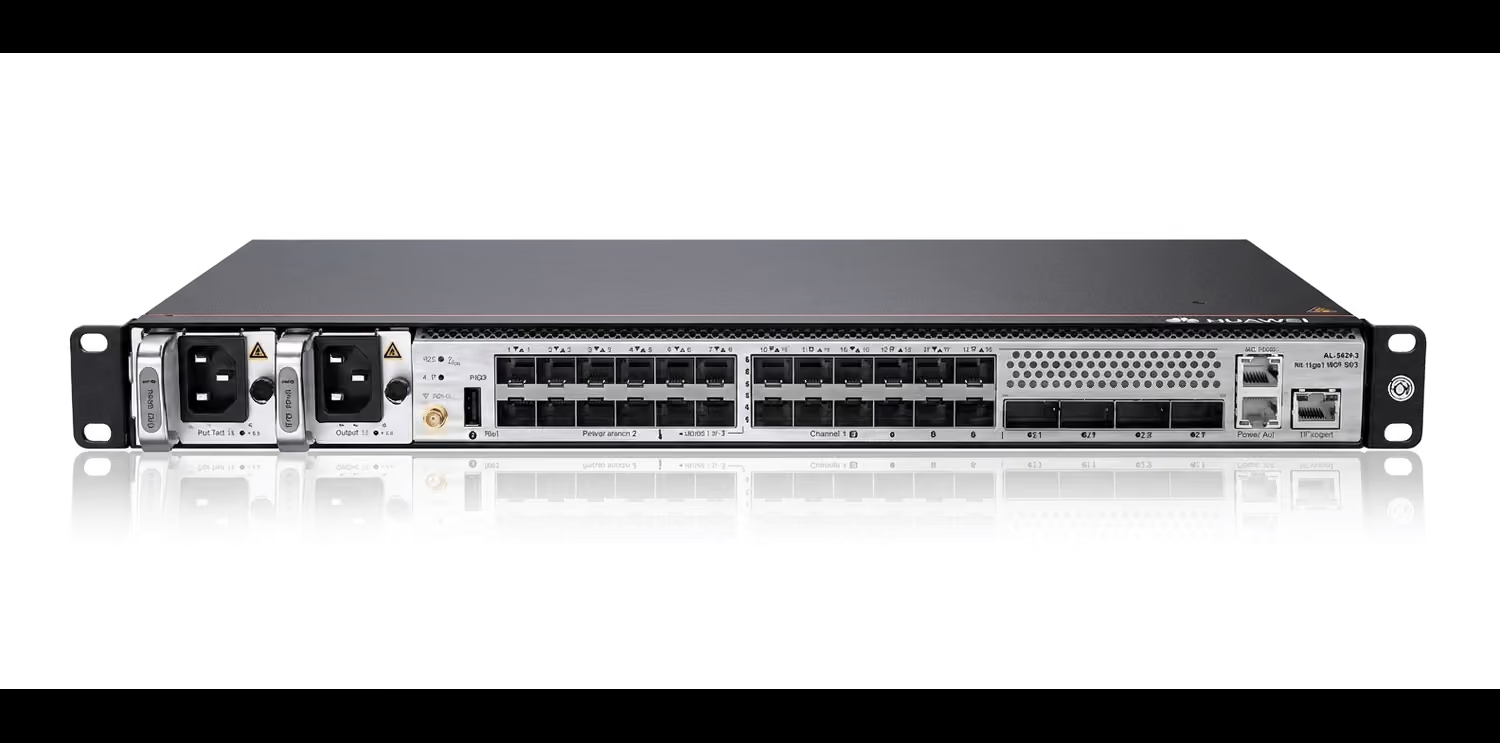
In an era defined by explosive traffic growth and the migration to cloud-native architectures, networks demand solutions that are powerful, compact, and future-proof. The Huawei NetEngine 8000E M1D Universal Service Router is engineered to meet these challenges head-on, delivering massive switching capacity in an ultra-compact 1U chassis.
With a 1.76 Tbps switching capacity and a shallow 220mm depth, the NE8000E M1D provides exceptional performance density, saving valuable rack space without compromising on capability. It is designed for versatility, supporting a wide range of high-speed interfaces and operating reliably across an industrial temperature range, making it a robust foundation for IP backbone, metro, data center, and mobile backhaul networks.
Built for the next generation of intelligent IP networks, this router features full support for SRv6, telemetry, and high-precision clock synchronization. It integrates multiple functions into a single platform to simplify network architecture, provide reliable service quality, and enable the evolution towards automated, self-driving networks.
The NetEngine 8000E M1D is more than a collection of high-speed ports; it's a forward-looking platform built on a programmable Network Processor (NP). This advanced architecture ensures the router can adapt to future protocols and service requirements, protecting your investment and enabling seamless network evolution. Its design prioritizes operational efficiency, with a typical power consumption as low as 80-125W, reducing the total cost of ownership in demanding environments.
Beyond raw performance, the router incorporates intelligent technologies to optimize traffic and enhance service quality. Deterministic IP (DIP) technology prevents packet collisions to ensure stable, low-latency performance for critical applications. For costly WAN links, Data Redundancy Elimination (DRE) technology actively compresses data, significantly reducing bandwidth consumption and operational expenses. This combination of power, intelligence, and efficiency makes the NE8000E M1D a strategic asset for any modern network.
Selecting the right universal service router is a critical decision that impacts network scalability, performance, and operational efficiency for years to come. The Huawei NetEngine 8000E M1D offers a wide range of features and configurations that must be carefully mapped to specific architectural and business requirements.
NEXUS ITX helps organizations navigate this complexity. We facilitate a thorough evaluation process, focusing on aligning the router's advanced capabilities—from SRv6 readiness to port density—with your unique environment and strategic goals. Our approach is centered on ensuring the technology you select is the technology you need.
Q: What is the primary benefit of the NetEngine 8000E M1D's compact 1U design?
A: The primary benefit is its high performance-to-space ratio. With a 1.76 Tbps switching capacity in a 1U chassis only 220mm deep, it can be deployed in space-constrained cabinets at aggregation sites, data centers, or enterprise locations, saving significant rack space and associated costs.
Q: How does SRv6 support benefit my network?
A: SRv6 (Segment Routing over IPv6) simplifies the network protocol stack by removing MPLS, leading to easier configuration and management. It enables network programming, allowing for flexible service provisioning, automated O&M, and rapid deployment of new services like 5G and cloud private lines.
Q: What kind of environments can the NE8000E M1D operate in?
A: The router is designed for high availability in a wide range of environments. Its industrial wide temperature design allows it to operate reliably in temperatures from -40°C to 65°C, making it suitable for both controlled indoor data centers and less-controlled outdoor or industrial locations.
Q: What is Deterministic IP (DIP) and why is it important?
A: Deterministic IP (DIP) is a technology that ensures packets experience a stable, predictable, and low latency as they traverse the network. It achieves this by preventing packet collisions and optimizing forwarding paths, which is critical for latency-sensitive applications like financial trading, industrial automation, and 5G services.
Q: How does Data Redundancy Elimination (DRE) help reduce costs?
A: DRE analyzes network traffic to identify and eliminate redundant data patterns before they are transmitted over a Wide Area Network (WAN) link. By compressing the data, it significantly reduces the amount of bandwidth required, which can lead to substantial cost savings on expensive WAN connections.
Q: What are the main port configuration options available?
A: The NetEngine 8000E M1D offers flexible port configurations up to 880G of capacity. Common combinations include 4x100GE, 16x25GE, or 24x10GE, along with support for various other interface speeds like 50GE, 40GE, GE, and FE. This flexibility allows it to adapt to diverse connectivity needs.
Q: How can Nexus ITX help me decide if the NE8000E M1D is right for me?
A: Nexus ITX can help you evaluate the NE8000E M1D's technical specifications against your specific network requirements. We can facilitate a comparison of its features, port configurations, and performance metrics with your architectural needs to help you determine if it is the optimal solution for your use case.
Contact us to evaluate the technical specifications and align the right NetEngine 8000E M1D configuration with your network architecture.