NetEngine 8000E M6 Universal Service Router
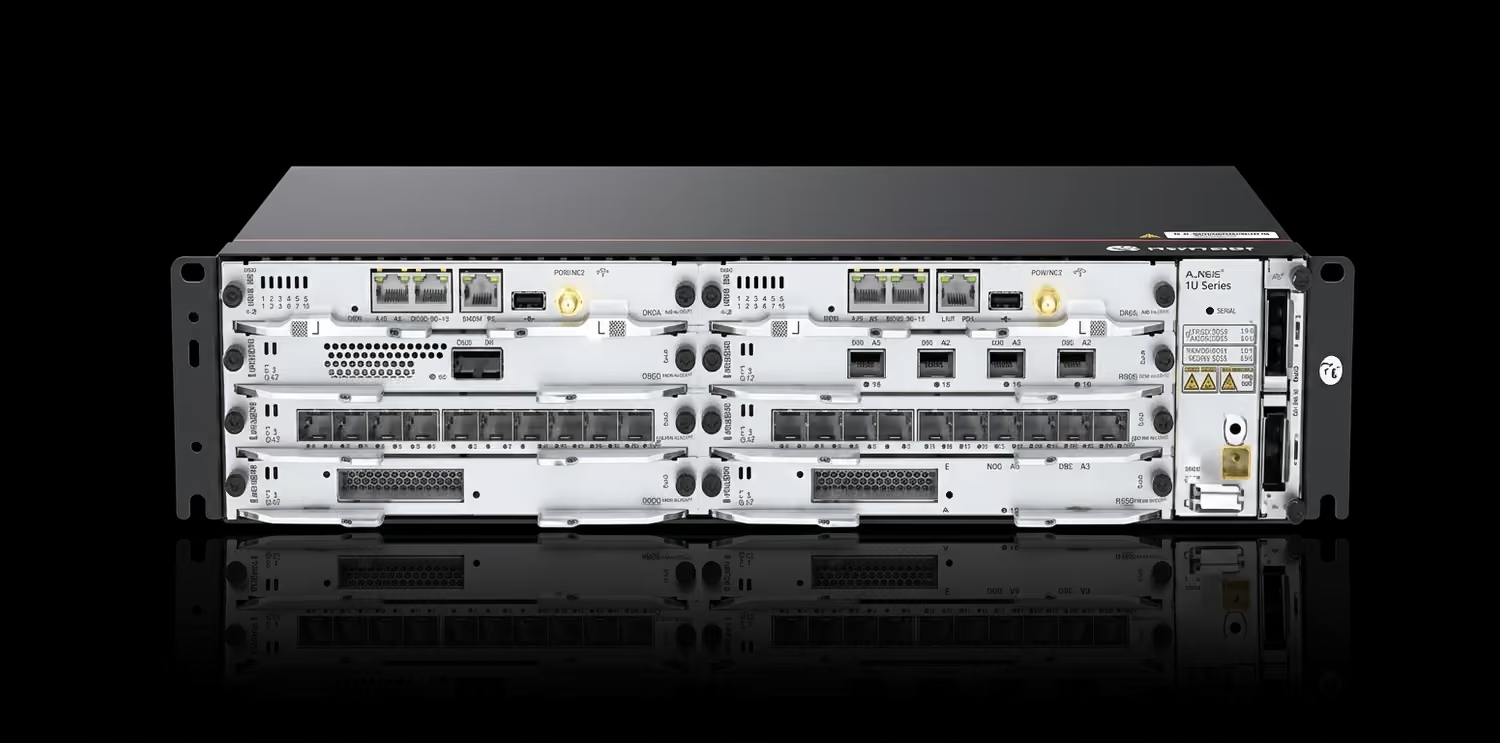
In the era of cloud computing and exponential data growth, network infrastructure must be more agile, efficient, and versatile than ever. The Huawei NetEngine 8000E M6 Universal Service Router is engineered to meet these demands, offering a powerful, all-scenario converged bearer solution in a remarkably compact 2U chassis.
Designed for space-constrained environments without compromising on performance, the M6 integrates private line aggregation, Internet Gateway (IGW), and Data Center Gateway (DC-GW) functions into a single platform. This 3-in-1 approach simplifies network architecture, reduces operational complexity, and lowers capital expenditure, providing a clear path to modernizing IP backbone, metro, and data center networks.
The NetEngine 8000E M6 is built on a future-oriented Network Processor (NP) architecture, ensuring programmability and the capacity to evolve with emerging network technologies. It delivers a robust 320 Gbps of switching capacity while supporting an extensive range of interfaces, from legacy E1 to modern 50GE, enabling seamless integration into diverse network environments.
At its core, the M6 fully supports next-generation unified network protocols like SRv6 and EVPN. SRv6 simplifies network protocols, facilitates large-scale networking, and provides end-to-end service bearer capabilities, making it ideal for enterprise cloud migration and multi-service convergence. Combined with its industry-leading network slicing and high-precision clock synchronization, the NetEngine 8000E M6 is a versatile platform for building intelligent, resilient, and scalable IP WANs.
Navigating the complexities of modern network hardware requires a clear understanding of how a product aligns with specific architectural goals and business outcomes. NEXUS ITX provides the advisory framework to help your organization thoroughly evaluate the Huawei NetEngine 8000E M6 Universal Service Router against your unique technical and operational requirements.
We facilitate an in-depth assessment process, focusing on how the M6’s features—from SRv6 and network slicing to its physical form factor—can solve your specific challenges. This ensures your technology selection is based on a comprehensive, data-driven strategy.
Q: What makes the NetEngine 8000E M6 a "converged" or "3-in-1" router?
A: The NetEngine 8000E M6 integrates the functions of three traditionally separate devices: a private line aggregation router, an Internet Gateway (IGW) for internet access, and a Data Center Gateway (DC-GW) for cloud and DC interconnectivity. This convergence simplifies the network architecture, reduces the number of physical devices, and lowers both CAPEX and OPEX.
Q: How does the support for SRv6 on the M6 benefit network operations?
A: SRv6 (Segment Routing over IPv6) simplifies the network control plane by removing protocols like LDP and RSVP-TE. It embeds path information directly into the IPv6 packet header, enabling source-based routing, faster service provisioning, and easier traffic engineering. This leads to a more agile, programmable, and scalable network that is easier to manage.
Q: What are the primary differences between the NetEngine 8000E M6 DC and AC models?
A: The main differences are in power supply, service slot count, and operating temperature. The DC model uses –48V/–60V DC power, offers 6 service slots, and supports a wider operating temperature range of –40°C to +65°C. The AC model uses standard AC voltage, has 4 service slots, and operates from –20°C to +55°C.
Q: Is the NetEngine 8000E M6 suitable for deployment in locations without standard server rooms?
A: Yes, its compact 2U height, shallow 220mm depth, and wide-temperature design make it highly suitable for all-scenario deployments. The DC model, in particular, is built for harsh environments often found in outdoor cabinets or non-conditioned facilities, making it ideal for mobile backhaul and industrial applications.
Q: What types of services can benefit from the M6's network slicing capability?
A: Network slicing allows a physical network to be partitioned into multiple isolated, virtual end-to-end networks. This is highly beneficial for service providers who need to offer differentiated services with guaranteed SLAs. For example, one slice could be dedicated to high-bandwidth, low-latency 5G mobile traffic, while another could serve best-effort internet traffic, all on the same physical router.
Q: What is the maximum port capacity of the NetEngine 8000E M6?
A: The router supports a maximum board capability of 50GE and has a total switching capacity of 320 Gbps. The specific port density depends on the line cards selected. Nexus ITX can help evaluate your bandwidth requirements to determine the optimal card and port configuration for your needs.
Contact us to discuss your technical requirements and assess how the Huawei NetEngine 8000E M6 can enhance your network's performance and versatility.