NetEngine 8000E M8 Universal Service Router
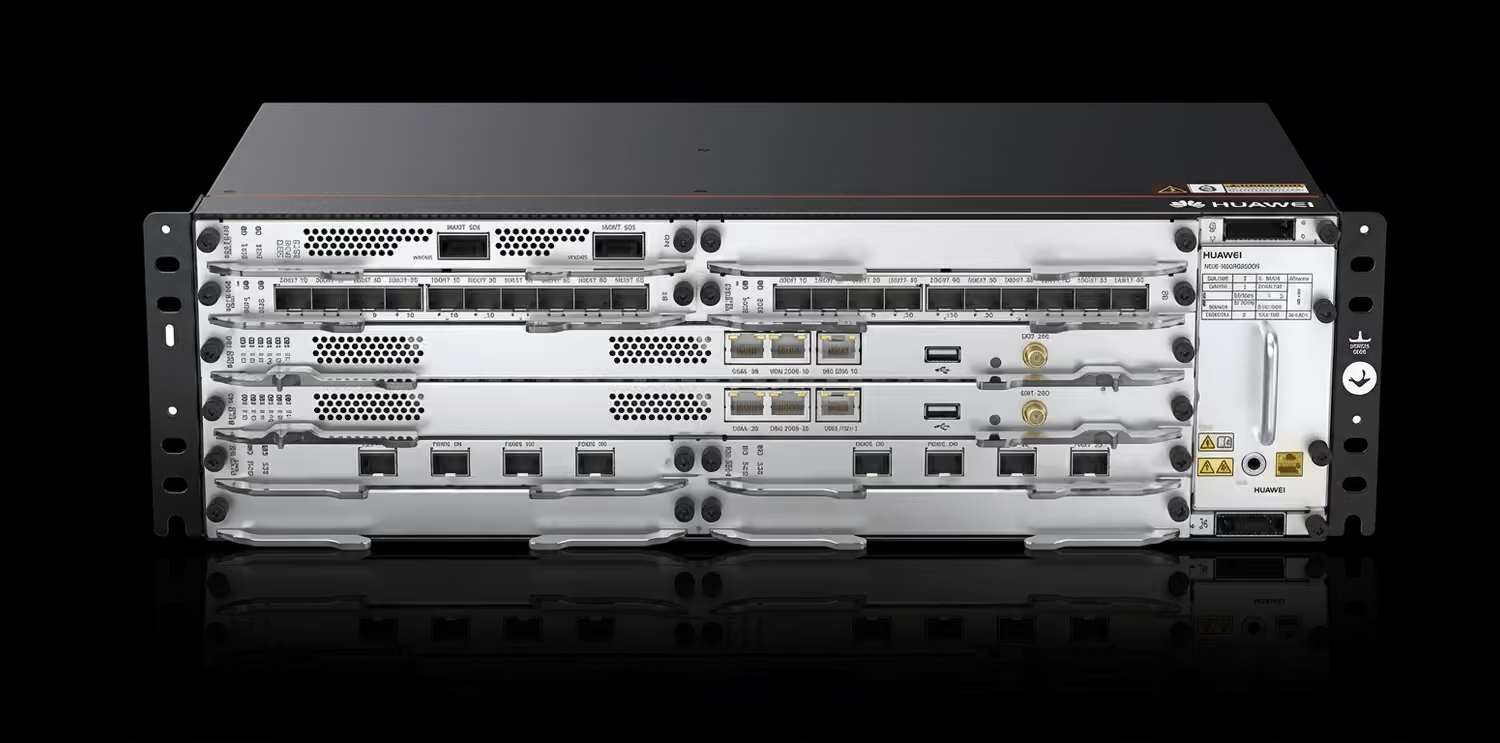
In an era of explosive traffic growth and increasing network complexity, organizations require a routing platform that is not only powerful but also simple, intelligent, and scalable. The demand for converged services—from enterprise private lines and cloud access to home broadband and mobile backhaul—puts immense pressure on traditional network architectures. A new approach is needed to reduce protocol complexity, automate operations, and deliver guaranteed service levels.
The Huawei NetEngine 8000E M8 Universal Service Router addresses these challenges directly. It is an all-scenario intelligent routing platform engineered for modern access and aggregation networks. Packing up to 2.4 Tbit/s of capacity into a remarkably compact 3U, 220mm-deep chassis, the NE8000E M8 provides unprecedented performance density. By converging private line, internet gateway, data center gateway, and BNG functions into a single 4-in-1 platform, it creates a streamlined, future-ready IP bearer network built for performance and efficiency.
At the core of the NetEngine 8000E M8 is a forward-thinking architecture designed to simplify network protocols and enable intelligent, application-aware connections. Full native support for SRv6 (Segment Routing over IPv6) is a key differentiator, allowing for the creation of programmable networks with automatic cross-domain connections and minute-level service provisioning. This technology dramatically reduces network complexity by consolidating over ten traditional protocols into just two, paving the way for more agile and automated network management.
The platform’s intelligence extends to its operations and maintenance capabilities. When integrated with Huawei’s iMaster NCE, the router utilizes In-situ Flow Information Telemetry (IFIT) to provide real-time, high-precision visualization of service level agreements (SLAs). This allows network teams to proactively monitor performance and locate faults in minutes, not hours. With a powerful Network Processor (NP) architecture and support for a full range of interfaces from GE to 400GE, the NE8000E M8 is built to evolve with your network demands.
Selecting the right universal service router involves a detailed analysis of your network architecture, service requirements, and future growth strategy. The Huawei NetEngine 8000E M8 offers a powerful combination of capacity, intelligence, and versatility, but aligning its specific capabilities with your unique environment is critical for maximizing return on investment.
Nexus ITX facilitates a comprehensive evaluation process for the NetEngine 8000E M8. We help your organization methodically assess how this platform can address your specific technical and business objectives, ensuring the chosen configuration is a precise fit for your needs.
Q: What is the primary advantage of the NetEngine 8000E M8's compact 3U, 220mm-deep design?
A: The compact design allows for highly flexible deployment, especially in space-constrained locations like remote access sites, enterprise equipment rooms, or co-location data centers where rack space is at a premium. It delivers enterprise and carrier-grade capacity (up to 2.4 Tbit/s) without requiring a full-depth cabinet.
Q: How does SRv6 support on the NetEngine 8000E M8 simplify network management?
A: SRv6 (Segment Routing over IPv6) significantly simplifies the network control plane by reducing the number of protocols required for traffic engineering and service delivery. It embeds path information directly into IPv6 packet headers, enabling network programmability, automatic cross-domain connections, and intelligent, SLA-based traffic steering without complex protocols like LDP and RSVP-TE.
Q: Can the NetEngine 8000E M8 support both modern and legacy network interfaces?
A: Yes. The platform is designed for versatility and supports a wide range of interface types, from high-speed 400GE, 100GE, and 25GE for modern backbones down to GE, FE, E1, and POS for legacy service integration and migration.
Q: What is In-situ Flow Information Telemetry (IFIT) and what problem does it solve?
A: IFIT is an intelligent O&M technology that provides real-time, high-precision visibility into network performance. It directly measures packet-level metrics like latency and packet loss for actual service flows. This allows network operators to visualize SLA compliance in real-time and locate faults with minute-level accuracy, a significant improvement over traditional, less granular monitoring methods.
Q: What is the difference between the NetEngine 8000E M8 DC and AC models?
A: The primary differences are the power supply type and corresponding operating parameters. The DC model uses a -48V DC input, common in telecommunications and data center environments, and supports a wider operating temperature range (-40°C to 65°C) and 8 service slots. The AC model uses standard AC voltage, is suited for enterprise environments, supports an operating temperature of -20°C to 55°C, and has 6 service slots. Nexus ITX can help evaluate which model best fits your facility's infrastructure.
Q: How does network slicing with FlexE work on this router?
A: Flexible Ethernet (FlexE) allows a physical Ethernet port to be logically divided into multiple, isolated slices. On the NetEngine 8000E M8, this enables network slicing where different services (e.g., mobile backhaul, enterprise private line, broadband) can run over the same physical infrastructure while receiving dedicated, non-interfering bandwidth and QoS, ensuring guaranteed performance for each service.
Contact us to discuss your technical requirements and evaluate how the Huawei NetEngine 8000E M8 can enhance your network architecture.